Shanghai, China
+86-17317656853
inquiry@cgprotection.com

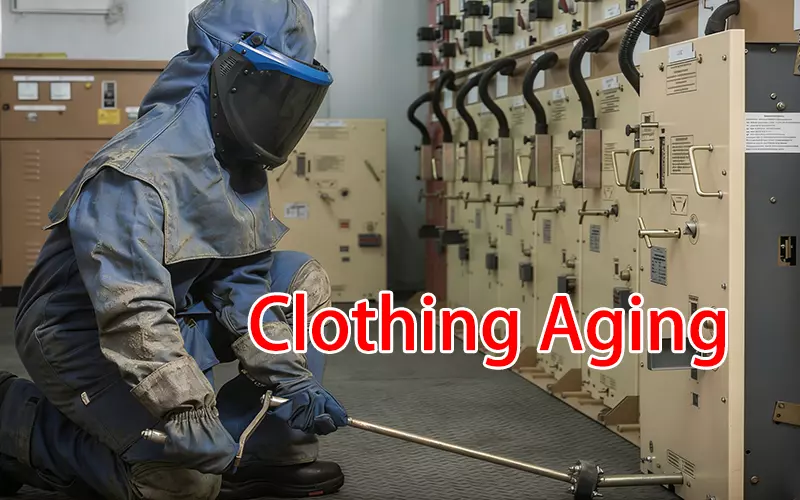
In high-risk environments such as power grid maintenance, energy storage systems, rail transit, and heavy industry, arc flash clothing is neither disposable PPE nor ordinary workwear that remains safe “as long as it is not torn.”
As service time increases, fabric aging is inevitable—and its impact on protective performance is often underestimated.
The real question is not:
“Can it still be worn?”
But rather:
“Does it still provide the level of protection it was originally certified for?”
From a materials engineering perspective, aging is not an accident—it is the result of cumulative, long-term exposure.
During its service life, arc flash clothing is repeatedly subjected to:
High temperatures and transient thermal shocks
Long-term ultraviolet (UV) exposure
Industrial dust, oils, and chemical residues
Repeated laundering, abrasion, and folding
Mechanical stress and localized strain
These factors do not cause immediate failure, but they gradually alter the microstructure and performance limits of the fabric.
The primary function of arc-rated fabrics is to:
Block intense radiant heat
Delay heat transfer to the skin
Resist molten metal and plasma splash during milliseconds of arc exposure
As aging progresses, fiber structures may develop:
Micro-cracks
Increased fiber breakage
Localized reductions in fabric density
These changes are usually invisible during daily wear. However, under high-energy arc exposure, they can result in:
Accelerated carbonization
Significantly reduced heat transfer delay
ATPV (Arc Thermal Performance Value) falling below the original design level
The most dangerous aspect is this:
Performance degradation is often not gradual—it can manifest as sudden failure during a single incident.
A common misconception is:
“If the garment does not continue burning, it is still safe.”
In reality:
Flame resistance ≠ Arc flash protection
Self-extinguishing behavior does not guarantee sufficient thermal energy blocking
Aged arc flash fabrics may still be flame resistant, yet exhibit:
Larger carbonized areas
Reduced control of thermal shrinkage
Increased risk of localized holes or fabric rupture
In real arc flash incidents, garments in this condition no longer provide the original safety margin.
Arc flash protection is not limited to fabric alone—it also depends on:
Structural integrity
Seam strength
Multi-layer system performance
As aging occurs:
Seams often lose strength before fabrics do
Stitching may tear under arc pressure
Layers may shift, collapse, or separate
This can cause:
Heat to concentrate and penetrate through weak structural points
Failure to spread from a single point to a larger area
In other words:
Aging compromises the reliability of the entire protective system, not just the fabric.
Use of chlorine bleach
High-temperature tumble drying
Excessive mechanical agitation in industrial washing
These practices directly damage fiber molecular structures and accelerate performance degradation.
In outdoor electrical work, UV radiation is a silent but highly destructive factor:
It weakens polymer chains
Reduces overall fabric strength
Increases susceptibility to rupture under arc energy
Certain industrial oils and chemicals can:
Alter surface energy characteristics
Change heat transfer behavior
Act as additional heat sources during arc exposure
Even when garments appear visually clean, residual contamination can significantly reduce real protective performance.
Determining whether arc flash clothing should remain in service cannot rely on visual inspection alone.
A more reliable assessment includes:
Whether service life exceeds the manufacturer’s recommended period
Whether laundering cycles approach or exceed validated limits
Whether the garment has experienced suspected arc exposure or abnormal thermal events
Presence of localized stiffness, brittleness, or loss of elasticity
In high-risk industries, a growing consensus is clear:
Arc flash clothing should not be worn until it physically fails—but retired when its protective performance can no longer be assured.
The value of arc flash clothing lies not in how long it can be worn,
but in whether it remains reliable at the critical moment.
When aging reduces protective performance, risk does not provide advance warning.
True safety management requires:
Understanding how aging affects arc protection
Establishing clear evaluation and replacement criteria
Incorporating “invisible performance degradation” into safety systems
Because in an arc flash incident:
Protective clothing is either effective—or it is not. There is no “almost safe.”
Tags:
Shanghai C&G's personal protective clothing and PPE products are trusted by customers in the world. Our products are exported worldwide, with a strong presence in the United States, China, Japan, Germany, the United Kingdom, India, France, Italy, Brazil, and Canada. In addition, we have a significant customer base in other countries across each continent, including Australia, New Zealand, South Africa, Nigeria, and Egypt in Africa; Argentina, Chile, and Mexico in South America; Russia, South Korea, and Indonesia in Asia; Spain, Poland, and Turkey in Europe; and Saudi Arabia and the United Arab Emirates in the Middle East. Wherever you are in the world, we have the products you need to stay safe and protected. Contact us today to learn more about our products and how we can help you meet your safety needs.











Shanghai C&G is committed to building a leading brand in the safety emergency industry with technological innovation as the core and sustainable development, providing customers with one-stop safety emergency solutions, escorting the safety of customers, and make the world safer!
Building 39, Lane 123, Shenmei Road, Pudong New District, Shanghai, China
inquiry@cgprotection.com
+86-21-38214394


© 2023 Shanghai C&G. All Rights Reserved.